ASHRAE Thailand Technical Visit Singapore 2026: Reflections from Ventpro
ASHRAE Thailand Technical Visit Singapore 2026 was an inspiring opportunity for Ventpro to learn from some of Singapore’s most advanced green buildings, district cooling systems, and sustainable tropical building concepts.
Ventpro was pleased to join the ASHRAE Thailand Chapter Technical Visit to Singapore 2026, together with engineers, professors, sustainability specialists, consultants, and HVAC professionals from Thailand.
The visit gave us the opportunity to study how Singapore integrates architecture, energy efficiency, district cooling, indoor comfort, water management, green infrastructure, smart controls, and sustainability into real building and city-scale solutions.
For Ventpro, this trip was not only an educational experience. It was also a reminder of how important it is to continue learning from international best practices and adapt them to the real challenges of Thailand’s tropical climate.
Learning from Singapore’s Integrated Building Approach
Singapore has become one of Asia’s leading examples of sustainable urban development and high-performance buildings. During the technical visit, we explored several projects that demonstrate how engineering, architecture, and sustainability can work together in practice.
The visit included several important projects and locations:
- Marina Bay District Cooling System
- Gardens by the Bay
- Labrador Tower
- STMicroelectronics district cooling system
- National University of Singapore – SDE4 Zero Energy Building
- Marina Barrage
- Marina One
- Jewel Changi Airport
Each project showed a different part of the same larger picture: future buildings and cities must be designed not only for energy efficiency, but also for comfort, health, resilience, and long-term sustainability.
District Cooling and Energy Efficiency
One of the most impressive parts of the visit was the Marina Bay district cooling system.
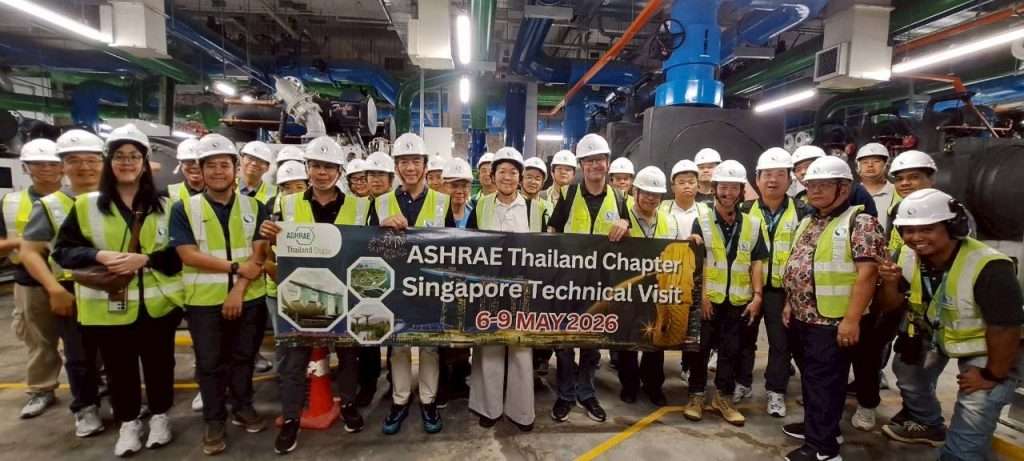
Instead of each building operating its own separate cooling plant, district cooling allows chilled water to be produced centrally and distributed to multiple buildings through a network. This can improve energy efficiency, reduce equipment duplication, and support more sustainable urban development.
For hot and humid regions such as Southeast Asia, cooling energy is one of the biggest challenges in buildings. Learning how Singapore approaches large-scale cooling infrastructure is highly relevant for the future of commercial buildings, hotels, offices, mixed-use developments, and large urban projects in Thailand.
District cooling also shows the importance of thinking beyond individual buildings. In dense urban areas, energy efficiency is not only a building-level issue. It can also be part of a city-scale strategy.
Green Buildings and Sustainable Design
Projects such as Gardens by the Bay, Marina One, Marina Barrage, and Jewel Changi Airport showed how sustainability is not only about mechanical systems. It is also about how buildings and public spaces are planned, designed, and experienced by people.
These projects combine greenery, daylight, water management, public space, architecture, ventilation, cooling, and energy strategies into one integrated design.
This is an important direction for the future of building design in tropical climates. Good buildings should not only consume less energy. They should also create better indoor and outdoor environments for the people who use them.
Singapore demonstrates that sustainability is strongest when engineering, architecture, landscape design, and human comfort work together from the beginning of a project.
Indoor Air Quality, Comfort, and Human Well-Being
For Ventpro, one of the most important takeaways from the trip was the connection between energy efficiency and indoor environmental quality.
A building should be energy efficient, but it must also be healthy and comfortable. In tropical climates, this means paying careful attention to:
- Indoor Air Quality (IAQ)
- Humidity control
- Outdoor air treatment
- Filtration
- PM2.5 protection
- Thermal comfort
- Air movement
- Commissioning and performance verification
These topics are closely connected to Ventpro’s daily work in Thailand. Our focus is not only to install ventilation equipment, but to create indoor environments that support comfort, health, and long-term building performance.
In Thailand, many buildings still rely mainly on air conditioning without enough controlled fresh air, filtration, humidity management, or verified airflow. This creates opportunities to improve both health and energy performance through better ventilation and indoor climate design.
Labrador Tower and Active Chilled Beam Systems

Labrador Tower was an especially interesting project from an indoor climate perspective.
The building combines high-performance façade design, efficient cooling systems, Dedicated Outdoor Air Systems, smart controls, and active chilled beams to support energy efficiency and occupant comfort.
For Ventpro, active chilled beam technology is particularly relevant because it connects strongly with Scandinavian indoor climate philosophy: good comfort, low air velocity, low noise, efficient water-based cooling, and careful control of the indoor environment.
In tropical climates, chilled beam systems must always be designed together with proper outdoor air treatment, dehumidification, dew point control, and commissioning. When applied correctly, they can be part of a high-performance indoor climate solution.
This is highly relevant for future offices, hotels, premium residences, healthcare spaces, and commercial buildings in Thailand where comfort, energy efficiency, and indoor air quality are important.
NUS SDE4 and Hybrid Cooling Concepts
The visit to the National University of Singapore’s SDE4 building showed another important direction: hybrid cooling.
Instead of relying only on low-temperature air conditioning, hybrid cooling combines air conditioning with elevated air movement, such as ceiling fans. This allows indoor temperatures to be maintained at a higher level while still supporting comfort.
This concept is highly relevant for the future of tropical building design. It challenges the traditional idea that comfort always requires very cold indoor temperatures. With good design, air movement, humidity control, and user adaptation, buildings can reduce cooling demand while still providing comfort.
For Thailand, these concepts must be adapted carefully, especially because of PM2.5 pollution, outdoor humidity, building airtightness, and user expectations. But the direction is very important: future buildings need to balance comfort, energy, air quality, and climate conditions together.
Why This Matters for Thailand
Thailand faces many of the same challenges as Singapore, but with different local conditions.
We have a hot and humid climate, high cooling demand, periods of severe PM2.5 pollution, moisture-related building problems, and many buildings with limited mechanical ventilation. This makes indoor climate design especially important.
For Ventpro, the trip reinforced the importance of combining:
- Energy recovery
- Humidity management
- High-quality filtration
- Verified airflow balancing
- Commissioning
- Comfort cooling
- Smart controls
- Long-term service and performance follow-up
Good ventilation is not only about bringing air into a building. It is about controlling the whole indoor environment.
Fresh air, filtration, humidity, temperature, pressure balance, sound level, energy use, and long-term operation all need to work together. This is where design, installation, commissioning, and service become just as important as the equipment itself.
Ventpro’s Direction
At Ventpro, we continue to develop ventilation and indoor climate solutions adapted for Thailand’s tropical climate.
Our work is inspired by Scandinavian principles such as precise air balancing, low sound levels, energy efficiency, commissioning, and verified performance. At the same time, these principles must be adapted to local realities in Thailand, including humidity, PM2.5, construction methods, energy costs, and customer expectations.
The ASHRAE Thailand Technical Visit to Singapore 2026 was an important opportunity to learn, exchange ideas, and see how advanced building concepts are being applied in real projects.
It also confirmed something we strongly believe: the future of buildings is not only about reducing energy consumption. It is also about creating healthier, more comfortable, and more sustainable indoor environments for people.
View the Technical Visit Summary PDF
For readers who would like to see more details from the visit, the ASHRAE Thailand Technical Visit Singapore 2026 summary PDF is available here:
Thank You
We would like to thank ASHRAE Thailand Chapter, the organizers, speakers, hosts, and all participants for an inspiring and meaningful technical visit.
At Ventpro, we believe the future of buildings in Southeast Asia will require closer cooperation between engineering, architecture, sustainability, indoor air quality, commissioning, and human comfort.
We will continue learning from global best practices and adapting them to the real challenges of Thailand’s tropical climate.
Feel Good Inside.